More Than Cosmetic: How Denver Enamel Shaping Supports a Healthier, Longer-Lasting Smile
Enamel shaping, also known as Enameloplasty or Odontoplasty, is a conservative tooth shaping dental procedure that corrects small chips, rough edges, and minor asymmetry while actively protecting your teeth for the long run. Enamel contains no nerve endings, so the procedure is painless and typically completes in 30 minutes to under an hour. Here’s why it belongs in the health conversation, not just the cosmetic one.
The Short Answer: What Enamel Shaping Actually Does
Enameloplasty is a minimally invasive procedure where a small amount of enamel is gently removed or smoothed to correct imperfections such as:
- chips
- uneven edges
- slight overlaps
- rough surfaces
No anesthesia is required, and the results are visible the same day.
Enamel is the hardest substance your body produces, and it also has no nerve endings. That’s why tooth shaping is painless. At Icon Dental, we use fine diamond burs and polishing discs to carefully sculpt the surface without touching the dentin underneath.
Most appointments wrap up in 30 minutes to under an hour, depending on how many teeth are involved. For patients who’ve been sitting with a rough edge that catches on their cheek or a chipped front tooth they’ve learned to live with, the change feels immediate.
Why Enamel Shaping Is a Health Procedure, Not Just a Cosmetic One
Most content on enamel contouring stops at aesthetics. We don’t think that’s the full picture.
Improved Oral Hygiene
Rough edges and slight overlaps between teeth create small traps for plaque and biofilm. When those surfaces are smoothed, brushing and flossing become more effective. Reducing those plaque-trapping areas lowers the risk of cavities and early gum disease over time.
Bite Balance
Not every tooth makes equal contact when you bite down. When certain teeth hit harder than others, those teeth absorb disproportionate force. Tooth contouring can adjust high contact points, distributing bite pressure more evenly and reducing accelerated wear on individual teeth.
Fracture Prevention
Jagged edges and sharp cusps concentrate stress. Smoothing them removes those weak points, making teeth less likely to chip or crack further. This is especially relevant for patients with minor existing chips that haven’t been addressed.
Research summarized by the Cleveland Clinic supports the functional benefits of enameloplasty beyond simple cosmetic correction. These aren’t side benefits of enamel tooth shaping. For us, they’re central to why we recommend it in the first place.
The Bite Balance Connection: Enamel Shaping and TMJ Health
Uneven bite contact doesn’t just wear down teeth. Over time, it can create strain in the jaw muscles and contribute to TMJ stress.
When specific teeth bear more force than they should, the jaw compensates. That compensation can show up as muscle tension, uneven wear patterns, or discomfort that patients often attribute to stress rather than their bite. Most cases are minor, but it’s a real consideration that skilled providers evaluate before doing any enamel contouring.
At Icon Dental, our downtown Denver dentists assess bite function and jaw alignment before reshaping a single tooth. For patients who may benefit from a broader evaluation, we also offer TMJ treatment in Denver as part of a coordinated care plan.
How Icon Dental Approaches Enameloplasty Differently
“We don’t fix a broken tooth only. We look at how to fix it but also why it got there so it doesn’t happen again.”
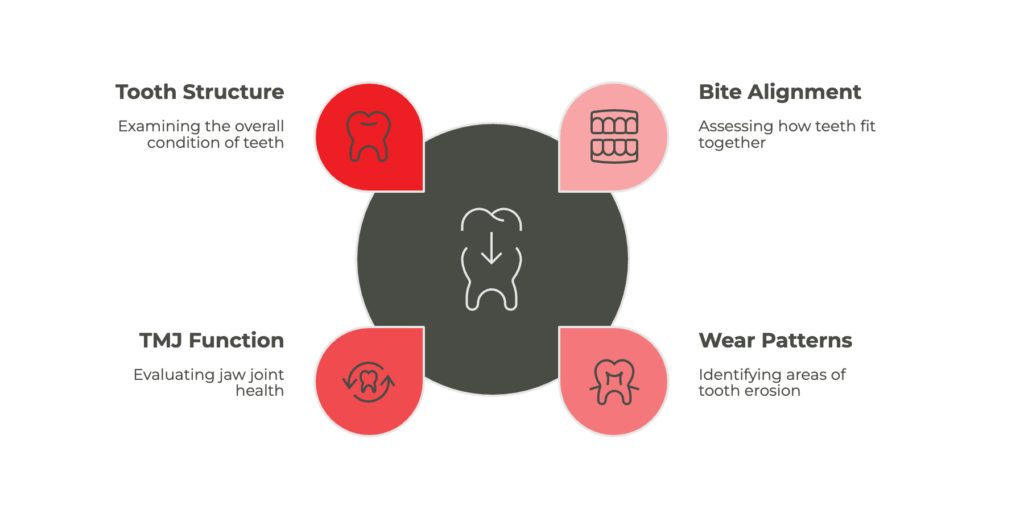
That’s how practice owner, Dr. Nazeli Tarjan, DDS, describes Icon Dental’s core philosophy, and it applies directly to enamel shaping. Before any reshaping begins, we evaluate bite alignment, wear patterns, TMJ function, and overall tooth structure. That evaluation changes what we do and which teeth we focus on.
Most Denver providers treat enameloplasty as a stand-alone polish, we treat it as part of a structured plan. A patient who comes in with a rough edge might also have a bite pattern that’s been causing uneven wear for years. Addressing only the cosmetic concern without understanding that context doesn’t serve the patient well.
Dr. Tarjan holds a Doctor of Dental Surgery from the University of Iowa College of Dentistry and a Bachelor’s degree in Psychology. She’s been recognized as a 5280 Magazine Top Dentist (2021) and holds Platinum Invisalign Provider status. Patients regularly describe their first visit as unlike anything they’ve experienced before. One noted, “I’ve never had such a thorough dental appointment before.” That thoroughness isn’t accidental, it’s how we’re built.
Who Is a Good Candidate for Tooth Shaping in Denver?
Many patients who benefit most from cosmetic teeth reshaping have been living with the issue for so long they assume nothing can be done, but that’s rarely the case.
Enamel shaping tends to work well for:
- Slightly chipped or uneven tooth edges
- Minor asymmetry between adjacent teeth
- One tooth that sits slightly longer than its neighbor
- Rough enamel surfaces that catch on your tongue or cheek
- Minor overlapping that doesn’t require orthodontic correction
It’s also worth knowing what enamel shaping is not suited for:
- Significant chips or fractures that need bonding or a crown
- Severe misalignment requiring clear aligners or orthodontics
- Structural damage or deep decay
What’s the best way to know if enamel shaping is right for you? A consultation with our downtown Denver dentists. We’ll evaluate your smile, bite, and tooth structure, with no pressure, just clarity. Schedule a conversation with our team when you’re ready.
Enamel Shaping, Dental Bonding, or Veneers: Which One Do You Need?
| Enamel Shaping | Dental Bonding | Porcelain Veneers | |
|---|---|---|---|
| Procedure type | Removes enamel to reshape | Adds tooth-colored resin | Thin porcelain shells bonded to tooth |
| What it corrects | Minor chips, rough edges, uneven length, slight overlaps | Chips, gaps, staining, minor shape changes | Staining, shape, size, significant cosmetic concerns |
| Invasiveness | Minimal (enamel only) | Minimal | Moderate (enamel reduction required) |
| Anesthesia | Not required | Usually not required | May be required |
| Session count | Single visit | Single visit | Multiple visits |
| Approximate cost | Among the most affordable cosmetic options | Affordable to moderate | Higher investment |
| Longevity | Permanent (enamel doesn’t regrow) | 5-10 years with care | 10-20 years with care |
| Best candidate | Minor cosmetic corrections with healthy teeth | Small chips, gaps, mild discoloration | Significant cosmetic changes, multiple concerns |
When Enameloplasty alone is sufficient, it’s almost always the better choice. It preserves natural tooth structure, costs less, and finishes in a single visit.
Sometimes enamel shaping and dental bonding can work together. Shaping removes an uneven edge, while dental bonding adds a small amount of material to refine the result. When a patient’s concerns are more significant, such as with heavy staining, larger chips, or multiple teeth needing a consistent look, cosmetic veneers may be the more appropriate next step.
For a side-by-side breakdown with more detail, read our article comparing enamel shaping vs. veneers.
What to Expect During and After Enamel Shaping
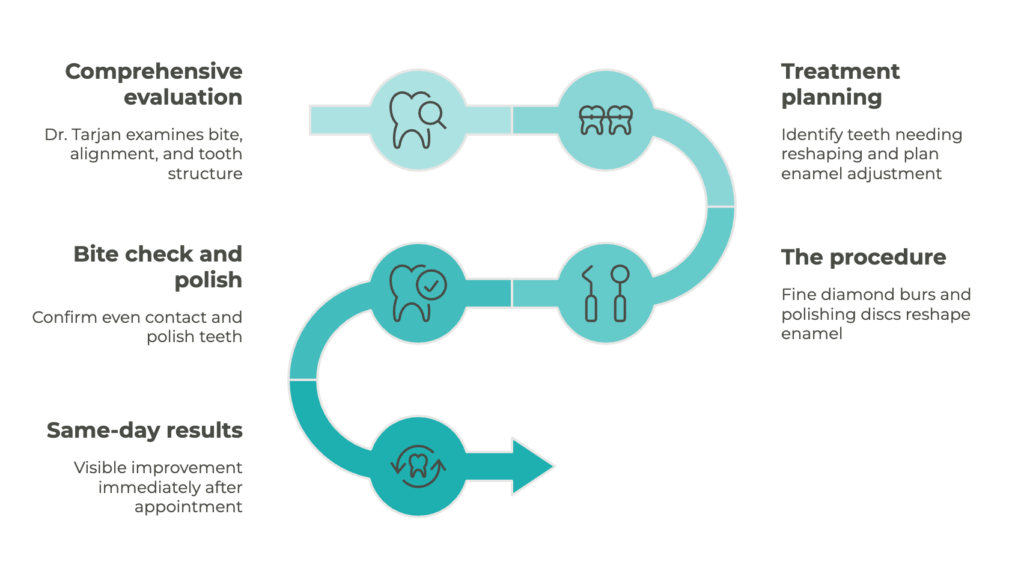
Here’s what a typical appointment looks like from start to finish:
- Comprehensive evaluation: Dr. Tarjan examines your bite, alignment, and overall tooth structure before any reshaping begins. This step is non-negotiable.
- Treatment planning: We identify which teeth need reshaping and map out exactly how much enamel will be adjusted on each.
- The procedure: Fine diamond burs and polishing discs gently smooth or reshape the enamel surface. There are no injections and no drilling into the dentin.
- Bite check and polish: After reshaping, we test your bite to confirm contact is even. The teeth are then polished to a smooth, natural finish.
- Same-day results: You leave the appointment with visible improvement, no waiting for lab work or follow-up visits.
Aftercare is straightforward, the majority of patients can eat and drink normally right away. Standard brushing and flossing continue as usual. For complete guidance, see our article on maintaining a great smile after an enamel shaping procedure.
One important note: because enamel doesn’t regenerate, the reshaping is permanent. That’s actually a reason to have it done well, with proper planning, rather than a reason to hesitate.
How Long Does Enamel Shaping Last?
Because enamel doesn’t grow back, the reshaping itself is permanent. The smoothed surface won’t wear off or fade.
That said, teeth can still chip or wear over time depending on grinding habits, diet, and bite patterns. A patient who grinds at night may need a custom night guard to protect reshaped teeth from additional wear. This is something we discuss during the planning phase, not after the fact.
The upfront bite assessment we do before every enameloplasty appointment is what makes results predictable. When we understand why a tooth wore unevenly in the first place, we can plan around it.
Frequently Asked Questions About Enameloplasty and Tooth Shaping
No. Enamel has no nerve endings, so the procedure itself is painless. Most patients are surprised by how comfortable it is. No injections and no numbing are needed.
Enameloplasty is one of the most affordable cosmetic dental options available. The exact cost depends on how many teeth are treated. During your consultation, we’ll give you a clear breakdown before anything is scheduled.
Most enamel shaping appointments complete in 30 minutes to under an hour. The evaluation and treatment planning happen before that, usually at your initial consultation.
Enamel shaping is typically classified as a cosmetic procedure, so coverage varies by plan. Our team can help verify your benefits before your appointment so there are no surprises.
Yes. Enameloplasty, odontoplasty, enamel contouring, tooth contouring, and tooth shaping all describe the same procedure. The terms are used interchangeably in dental practice.
Minor chips respond well to enamel shaping. For larger fractures or chips that have removed significant tooth structure, bonding or another restoration may be needed. A consultation lets us assess which approach fits your specific situation.
A Conservative Approach to a Lasting Result: Icon Dental’s Philosophy
We believe in preserving natural tooth structure whenever possible, and enamel shaping does exactly that. It delivers meaningful cosmetic and functional improvement by removing only what needs to be removed, without crowns, without veneers, and without more intervention than the situation calls for. Our approach to every procedure starts with the whole picture: bite, TMJ, alignment, and aesthetics together. Enameloplasty fits within that framework because it’s not a stand-alone touch-up. It’s part of how we build smiles that hold up. With over 600 Google reviews rated Excellent, a 5.0 rating on Opencare, a Healthgrades Compassionate Dentist designation, and a 5280 Magazine Top Dentist recognition, the feedback we hear consistently is that patients feel genuinely cared for and leave with a plan that makes sense.
You can explore our full range of cosmetic dentistry services to see how enamel shaping fits alongside bonding, veneers, and clear aligners as part of a complete smile plan. A little care today means a lifetime of healthy smiles.
Ready to See What Enamel Shaping Can Do for Your Smile in Denver?
If you’ve been sitting with a small chip, a rough edge, or a slight asymmetry and assuming that’s just how your teeth are, it doesn’t have to stay that way. A consultation at Icon Dental starts with a thorough evaluation of your smile, bite, and tooth structure. You’ll leave with a clear understanding of your options, whether or not you schedule treatment that day.
We’re located at 1425 Market St., Suite 100, Denver, CO 80202, in LoDo steps from Larimer Square and the 16th Street Mall Ride. Two easy ways to connect:
- Call us at (720) 645-2153
- For new or existing patients, book your appointment online
You can also visit our enamel shaping service page for a full procedure overview. Taking a closer look now is one of the simplest things you can do for the long-term health of your smile.