Sensitive Teeth Shouldn’t Stop You From Professional Teeth Whitening in Denver
If sensitivity has kept you from pursuing professional teeth whitening in Denver, you’re not alone, and you’re not out of options. Many patients who visit us at Icon Dental have avoided whitening for years, assuming their sensitivity made treatment off-limits. Our Downtown Denver practice, located at 1425 Market St., Suite 100 in LoDo, takes a different approach: we find out why your teeth are sensitive before we recommend any whitening protocol. That changes everything about the experience.
The Short Answer: Sensitivity and Whitening Can Coexist
Teeth sensitivity after whitening is common, usually temporary, and largely preventable when treatment is professionally supervised. Professional whitening uses controlled-strength gels, custom-fitted trays, and gum isolation techniques that OTC products simply don’t offer. With the right pre-treatment evaluation, most patients with sensitive teeth whiten comfortably and see meaningful results.
Why So Many Denver Patients Avoid Whitening (And Why That’s Changing)
If you’ve avoided teeth whitening because of sensitivity, you’re not alone. Some patients have tried store-bought strips and ended up with sharp, shooting discomfort that lasted days. Others already live with mild sensitivity and assume that professional whitening will only make things worse.
Both experiences are valid, and both are worth examining more carefully. The pain from over-the-counter (OTC0 strips usually comes from ill-fitting trays that let gel leak onto the gums, combined with concentration levels that weren’t adjusted for your specific enamel status. That’s a product problem, not a you problem!
What we see at Icon Dental mirrors a pattern: patients who have normalized discomfort and have concluded that nothing can be done. Once they learn that sensitivity is a diagnosable, treatable clinical signal rather than a permanent barrier, the conversation changes. You can learn more about how we approach sensitive-tooth whitening on our professional Denver teeth whitening page service page.
What Actually Causes Teeth Sensitivity During Whitening
Whitening gels work by releasing hydrogen peroxide or carbamide peroxide, which penetrates the enamel and reaches the underlying dentin. This temporarily increases the permeability of dentinal tubules, the tiny channels that run from the outer tooth surface toward the nerve. When those tubules are more open, temperature changes and pressure are felt more acutely. It’s a short-term, reversible process in healthy enamel, not a sign of damage.
That being said, some sensitivity during whitening goes beyond this normal mechanism. Gum recession, enamel erosion, bruxism, untreated decay, and TMJ-related grinding all create conditions where whitening gel can cause more significant discomfort. These are root causes, not incidental factors, and we evaluate all of them before any whitening treatment begins.
Understanding the difference between expected whitening sensitivity and sensitivity driven by an underlying condition is exactly what a thorough pre-treatment consultation is designed to uncover.
Sensitivity from Whitening vs. Sensitivity from an Underlying Condition
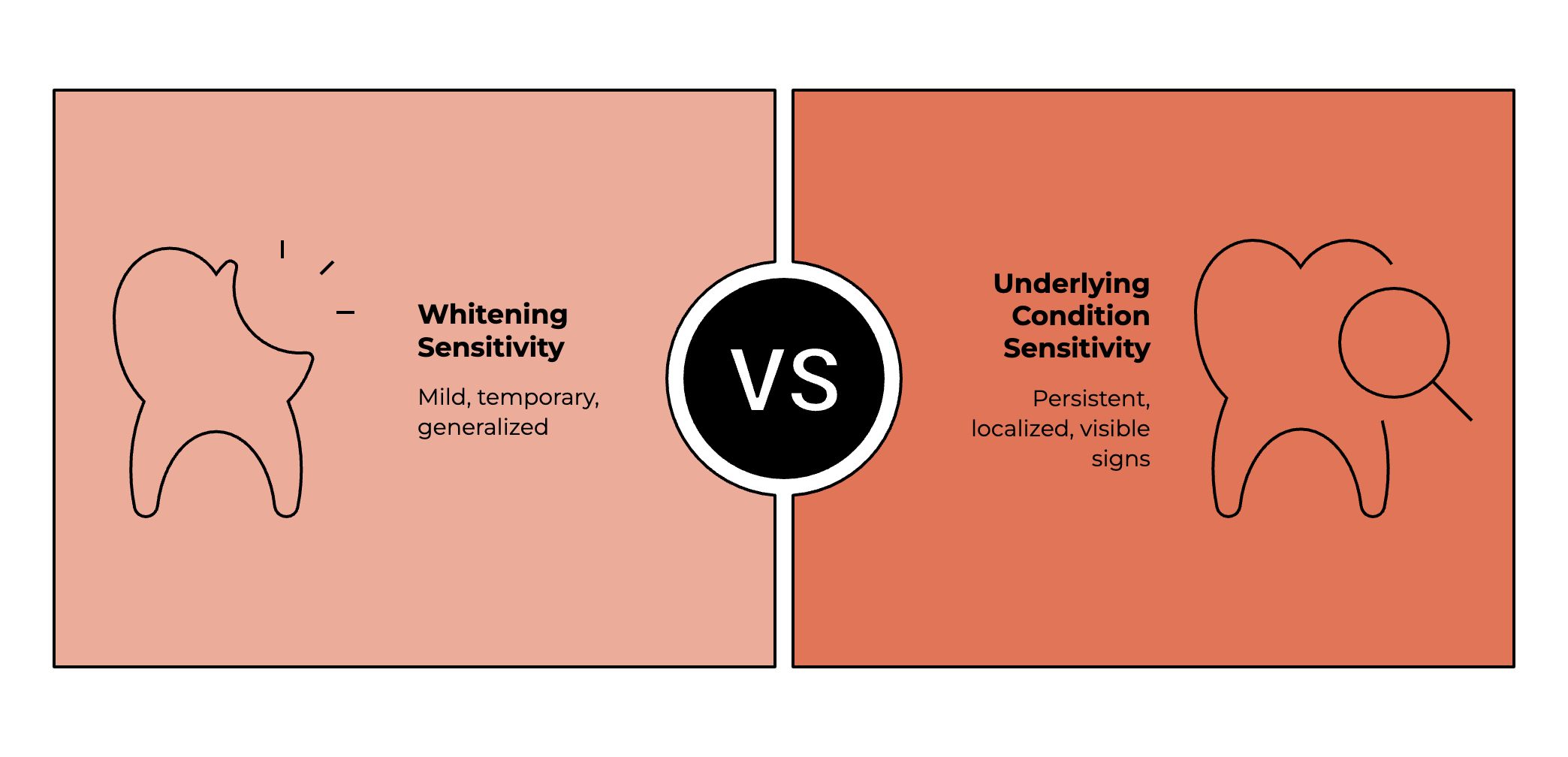
- Normal whitening-related sensitivity typically feels like mild zingers or heightened cold sensitivity. It usually begins during or shortly after treatment and resolves within 24 to 48 hours. It’s generalized across multiple teeth, not localized to one spot.
- Sensitivity from an underlying condition looks different. It may be persistent, concentrated on one specific tooth, or accompanied by visible signs like gum recession or worn enamel surfaces. When sensitivity fits that profile, something else is driving it, and whitening without addressing that cause won’t end well.
That’s why a professional exam before any teeth whitening procedure is important. Assessing enamel health and identifying any erosion or structural vulnerability allows us to build a whitening plan that won’t aggravate existing problems.
How Icon Dental Approaches Whitening for Sensitive Patients
Our philosophy is to look at the basement up, with a structured forward plan. We don’t apply whitening gel and hope for the best. Before recommending any whitening protocol, Dr. Nazeli Tarjan, DDS, evaluates bite patterns, gum recession, enamel integrity, bruxism activity, and any signs of TMJ-related grinding. Each of those factors directly influences how your teeth will respond to whitening treatment.
This evaluation happens within our 90-minute new patient appointment, a format we’ve built specifically because your dental situation is both unique and worth the time it takes to understand properly. A comprehensive dental exam isn’t a prerequisite we require to slow things down; it’s the reason our whitening outcomes are predictable rather than accidental.
Chain whitening studios and OTC products skip this step entirely. These are what produce the painful, inconsistent results patients describe when they arrive at our office frustrated and skeptical. We’re here to give a different answer.
If you’d like to discuss your sensitivity concerns with our team before committing to anything, we’re happy to walk through your options. Reach out at (720) 645-2153 or visit our contact page to schedule a consultation.
Controlled Gels, Precise Timing, and Gum Isolation: The Professional Difference
- First, we calibrate gel concentration to your enamel status, not to a maximum-strength default.
- Second, we control exposure time precisely, because overexposure is one of the most preventable causes of post-whitening sensitivity.
- Third, we apply protective gum barriers before any gel contacts your teeth, keeping whitening agents away from soft tissue entirely.
OTC strips and generic trays provide none of these controls. The trays don’t fit your teeth, so gel migrates. The concentration isn’t matched to your sensitivity level. And there’s no clinician monitoring how your teeth are responding in real time. The result is often unnecessary discomfort that patients then attribute to whitening itself, when the real culprit was the lack of professional oversight.
In-Office Laser Teeth Whitening in Denver vs. Custom Take-Home Trays: Which Is Right for Sensitive Patients
For patients asking about laser teeth whitening in Denver, this is the question that actually determines your outcome: which pathway fits your teeth, your schedule, and your sensitivity level?
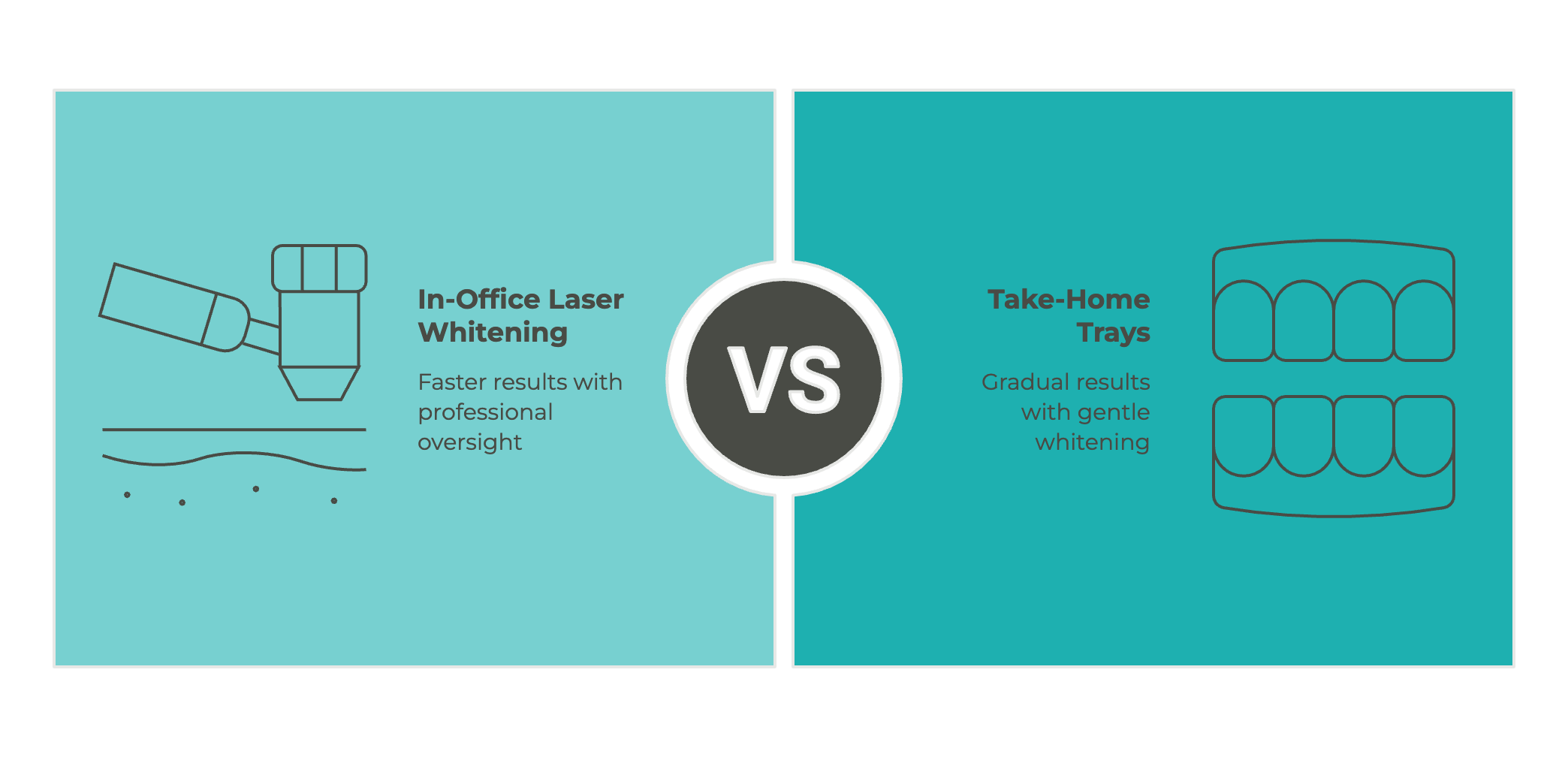
In-office whitening uses a professional-strength whitening gel activated by laser or light technology, with our laser dental treatment equipment allowing precise, controlled application. Laser activation accelerates the whitening reaction, which means less total exposure time compared to passive gel application. Results are visible in a single appointment, with the full process monitored by our clinical team from start to finish.
Custom take-home trays use a lower-concentration gel worn over a series of days or weeks. Because the concentration is gentler, the whitening process is more gradual. For patients with moderate to significant existing sensitivity, this pathway is often the better starting point. The trays are custom-fabricated to fit your teeth exactly, eliminating the gum contact that makes generic trays so problematic.
Dr. Tarjan guides every patient toward the option that fits their oral health status. For some, in-office treatment is the right call. For others, take-home trays provide a gentler introduction that achieves excellent results with less risk of discomfort. And for some patients, a combination of both delivers the best of each approach.
A Quick Comparison: In-Office Laser Whitening vs. Take-Home Trays for Sensitive Teeth
- In-office laser whitening delivers visible results in one appointment, uses professional-strength gel calibrated by a clinician, and involves direct real-time monitoring throughout. It suits patients who want faster results with professional oversight, and sensitivity is managed through gum isolation, timed exposure, and immediate adjustment if needed.
- Custom take-home trays produce gradual results over days or weeks, use lower-strength gel for gentler whitening, and are self-applied following instructions from your dental team. They work best for patients who have existing sensitivity or prefer a gradual approach, and the lower concentration reduces nerve stimulation risk throughout the process.
Both options are valid. The right choice depends on where your teeth are starting from.
Professional Teeth Whitening Cost in Denver: What to Expect
Professional teeth whitening cost in Denver varies depending on several factors, and quoting a single number without context wouldn’t serve you well. The type of treatment matters: in-office whitening and custom take-home trays are different investments with different timelines and results profiles. The number of sessions needed, whether preparatory care like a cleaning or enamel assessment is required, and the custom nature of professionally fabricated trays all influence the final figure.
What we can say clearly is that the cost of professional whitening includes things OTC products don’t provide: a pre-treatment evaluation of your enamel and sensitivity status, calibrated gel concentration, gum isolation, and a clinician available if you’ve questions or concerns before, during, or after treatment. That’s not a premium for the sake of it. That’s what produces predictable long-term outcomes instead of hoping the box instructions were sufficient.
To get an accurate picture of your specific whitening options and what they involve, a consultation with our team is the right first step. Call us at (720) 645-2153, or visit our Denver teeth whitening service page to learn more.
What Our Denver Patients Say About Teeth Whitening at Icon Dental
The feedback we hear most often isn’t about shade results, though those matter too. It’s about the appointment itself. Patients consistently tell us they’ve never had a dental visit that thorough before. That phrase captures something important about how we work: the whitening treatment is built on an evaluation that actually takes the time to understand your teeth.
Icon Dental holds a Healthgrades Compassionate Dentist designation and more than 615 Google reviews rated Excellent. Dr. Tarjan has been named a 5280 Magazine Top Dentist, a recognition that reflects both patient outcomes and the depth of care that goes into every appointment. Our goal, as she describes, is to create raving fans who say “you changed my life.” That standard applies to whitening just as much as it applies to any other service we offer.
We’ve also had patients come to us after CPAP fittings elsewhere, grateful simply because we were the first provider to screen for the connection between their dental health and their sleep quality. That same root-cause attentiveness informs how we approach whitening. Schedule your whitening consultation by booking an appointment online, or calling (720) 645-2153.
Frequently Asked Questions About Teeth Whitening and Sensitivity
Yes, mild sensitivity after a whitening treatment is common and expected. It typically feels like brief zingers or heightened cold sensitivity and resolves on its own within 24 to 48 hours. If sensitivity is severe or persists beyond that window, contact your dental provider.
For most patients, sensitivity from professional whitening is short-lived and resolves within one to two days. How long sensitivity lasts after whitening can vary based on your baseline enamel condition and the concentration of gel used. Professional supervision helps keep that window as short as possible.
In most cases, yes. Existing sensitivity isn’t an automatic disqualifier for whitening; it’s a signal that the treatment plan needs to account for your specific situation. A pre-treatment evaluation helps us identify what’s driving the sensitivity and adjust your protocol accordingly.
Laser whitening can be appropriate for sensitive patients when gum isolation, precise timing, and clinician monitoring are all in place. The laser activation process can actually reduce total exposure time compared to some other methods, which benefits sensitivity-prone patients.
Professional whitening uses calibrated gel concentrations, custom-fitted trays or direct application, and protective gum barriers. OTC products offer none of these controls, which is why they more frequently cause gum irritation and uneven sensitivity responses.
Whitening sensitivity is typically temporary, mild, and generalized. If your sensitivity is concentrated on one tooth, accompanied by visible gum recession, or persists longer than two days after treatment, it may point to an underlying condition worth investigating before whitening continues.
Zoom teeth whitening in Denver uses light-activated gel and can cause temporary sensitivity, as all peroxide-based treatments can. When performed with proper gum protection and monitored exposure times, the sensitivity profile is manageable for most patients.
Avoid extremely hot or cold foods and beverages for 24 to 48 hours, use a sensitivity-formulated toothpaste with potassium nitrate, and give your teeth time to recover. If sensitivity doesn’t resolve within 48 hours, call your dental provider.
Practical Steps to Minimize Sensitivity Before and After Whitening
- Schedule a thorough dental exam before starting any whitening treatment so enamel condition, gum recession, and any underlying concerns are identified first.
- Use a sensitivity-formulated toothpaste containing potassium nitrate for two to three weeks before your whitening appointment to reduce baseline nerve reactivity.
- Avoid extremely hot or cold foods and beverages for 24 to 48 hours after treatment, giving your dentinal tubules time to return to their normal state.
- Follow the exposure times and instructions provided by your dental team exactly, because extending treatment to speed results is one of the most common causes of avoidable sensitivity.
- Let your provider know right away if sensitivity persists beyond 48 hours, as that timeline matters clinically and your team needs to know.
- If you have moderate existing sensitivity, consider starting with custom take-home trays at a lower concentration before moving to in-office treatment.
- Don’t substitute OTC products mid-protocol either, since switching products changes the concentration and fit variables your provider calibrated for your specific situation.
Ready to Whiten Without the Worry? Visit Icon Dental in Downtown Denver
Sensitivity has kept too many patients from a treatment they want and that, with the right approach, is genuinely appropriate for them. The difference isn’t a special gel formula or a better marketing promise. It’s a thorough evaluation built around your actual oral health, a treatment plan that accounts for what’s really happening in your mouth, and a clinical team that monitors your response throughout the process.
Our practice is located at 1425 Market St., Suite 100 in Downtown Denver’s LoDo district, steps from Larimer Square and accessible via the 16th Street Mall Ride. New patients are welcomed with 90-minute appointments because that’s the format that allows us to do this work properly. We’re not rushing through a cosmetic add-on; we’re building a whitening plan that fits into your whole-mouth health picture.
To schedule a whitening consultation, call us at (720) 645-2153, or visit our contact page. You can also learn more about your options on our professional teeth whitening in Denver service page.
A little care today means a lifetime of healthy smiles.